Transparency, Accountability, and Reform of Government
- Articles
republipeclr
- 0
- 22 minutes read
Trump Administration Doctrine of Governance
America at 250 Years: Adapt or Perish Free People Power!
The biggest obstacle facing America today is government bureaucracy: an extensive, unaccountable system that has grown so large it now stands in the way of the people it was created to serve. When the founders established our constitutional republic in 1776, the entire federal government was designed to be minimal, comprised of just four departments and a few thousand employees. (History of the United States government, 2024) Today, however, over 2 million civilian federal workers fill the ranks of hundreds of agencies and sub-agencies, constituting a staggering expansion far beyond their original extent. (How many civilian jobs are in the US federal government? 2025)
Since 1776, our constitutional republic has grown older and ossified in its structure. It has developed a fourth, unelected arm of bureaucracy on all our necks, with the government now involved in almost every part of our lives, sometimes even directly controlling them and wielding almost warlord-like, unaccountable, unelected and taxing powers over our democracy and republic. (McDonald, 2025, pp. 453-470)
To meet this challenge, we need clear solutions. In the pages that follow, Republican people of color, will propose a series of targeted reforms to shrink government, increase transparency, establish strict accountability, and empower citizens. These include measures like zero-based budgeting for federal agencies, term limits for top officials, mandatory performance audits, and full public reporting of government spending. By previewing these reforms now, it is clear this document doesn’t just diagnose a problem but lays out feasible steps for real change.
As we approach 250 years on July 4th, 2026, America faces a clear choice: change or risk decline.
To truly move forward, America needs specific reforms that make government smaller and more accountable. As immediate first steps, we should:
– Enact zero-based budgeting across all federal departments within the next two fiscal cycles, making sure that every dollar spent must be justified and unneeded expenditures are eliminated.
– Implement regular, independent performance audits for all major agencies within the first year of reform, making leaders directly accountable for waste or inefficiency.
– Establish strict term limits for top agency officials, with a maximum of eight years in any executive federal role, to prevent long-term entrenchment of power.
By centering on these initial, time-bound actions, we can show Americans that real progress is possible. After these, further reforms—such as cutting outdated regulations, empowering state and local governments, and mandating full transparency in government spending—can help return power to the people and reduce the burden of bureaucracy.
Our democracy and republic have become rigid, slow, and too large and costly. Over the last decade alone, federal government spending has increased by more than 40 percent, with the annual budget now topping $6 trillion—a dramatic expansion that affects every taxpayer. (Edwards, 2023) As Milton Friedman said, it is now a government run by bureaucracy for the people, but it has forgotten its main duty: to serve and protect us.
Abraham Lincoln called America a government of the people, by the people, for the people. In the 1980s, President Ronald Reagan described the modern government in harsh terms, summed up by his well-known quote:
“The most dangerous words in the English language are: I am from the government, and I am here to help.”
This line has echoed for decades, not just because of partisan distrust, but because it taps into a fundamental American skepticism about the reach of government. For many Americans, regardless of political belief, skepticism of concentrated power is a defining national trait. The phrase has become a kind of cultural shorthand for this instinctive wariness, familiar not just to conservatives but to anyone who values checks and balances and wants to ensure government stays responsive to the people. Across ideologies, citizens recognize the importance of keeping government power in check, no matter who is in office.
Government did help, but mostly themselves, by gaining more power, more control, more money and more authority over us.
The Growth of Inequality and Government Control
Over the past 60 years, both parties—led at different times by presidents like Lyndon B. Johnson with the Great Society programs, Richard Nixon’s expansion of federal regulatory agencies, Ronald Reagan’s support for large tax cuts alongside increased defense spending, Bill Clinton’s financial deregulation and trade agreements, George W. Bush’s expansion of entitlements like Medicare Part D and increased military budgets, Barack Obama’s Affordable Care Act and stimulus, and subsequent growth in spending under Donald Trump and Joe Biden—have too often chosen comparable paths: expanding government, increasing spending, and creating opportunities for powerful interests. (U.S. Debt by President: Dollar and Percentage 2025, 2025)
In Congress, bipartisan coalitions passed measures such as the Community Reinvestment Act reforms in the 1990s and permanent tax loopholes for specific industries in both Democratic and Republican majorities. (Community Renewal Tax Relief Act of 2000, 2000) As a result, the gap between the rich and the poor has grown so wide that government officials, big companies, and the wealthy control most of the resources, while regular people have less. (Rosenblum et al., 2025) While bipartisan policy choices, including unchecked growth in government programs, tax loopholes, and lax enforcement of regulations for large corporations, have played a major role in this outcome, external economic forces, such as globalisation and technological change, have also contributed to rising inequality. (Marr & Jacoby, 2021)
This is not simply a Republican or Democratic failure, but an outcome of a system where both parties, influenced by special interest groups and elite donors, consistently made decisions that benefited political insiders over ordinary Americans. (Kim et al., 2025)
Key examples include the financial bailouts during the 2008 crisis, which largely protected major banks at taxpayer expense, and repeated votes to expand entitlement and defense spending without equivalent accountability or reform. (Troubled Asset Relief Program, 2024)
Now, at 250 years, Americans either work to support the government or work for it. (How many people work for the federal government? 2025) If there is to be true reform, it must be nonpartisan and focused on putting the interests of ordinary Americans first.
While historical situations obviously differ, a story from ancient Egypt—told in the Bible, Torah, and Quran—illustrates a long-standing human response to government excess: Hebrew enslaved people rebelled when the Pharaohs took 25% of what they grew and earned. Today in America, which Ronald Reagan called the last bastion of freedom, we pay almost 40% of what we make in taxes, fees, and other growing ways the government collects money. (OECD, n.d.)
This happens in a country where people of every background, culture, religion, and belief call themselves citizens of Free People Power in America. Yet the same excuse is still used:
“We are from the government, and we are here to help.

Government is a Monopoly and the Trump Doctrine reducing it down.
According to a report from the White House, the Trump administration has sought to reduce the size of government through efforts such as halting proposed Biden-era regulations, which it says have saved Americans over $180 billion, or $2,100 per family of four, by cutting back on federal rules and centralized control of Americans’ hard-earned money. In turn, this is meant to boost the personal economy, so Americans can have more and live happier lives.
Before the Trump administration’s tax cuts and deregulation, the country was heading toward higher taxes, bigger government, and more central control.
Time has shown that these reforms are effective in the first year.
Transparency in Economic and National Security
In national economic security, top-down control is now being challenged by calls for openness. According to a report highlighted by RealClearInvestigations, while USAspending.gov was created to let the public review government contracts and track federal spending, the Government Accountability Office found that 49 federal agencies have not reported their spending to the site, limiting its potency in targeting fraud and waste. In fact, these agencies account for close to 15 percent of all federal outlays, creating a transparency blind spot of roughly $650 billion each year that escapes public scrutiny. (Sánchez & Brady, 2024)
This staggering gap makes it far more difficult to hold officials accountable, and it demonstrates how much of the federal budget remains outside the public eye.
In national security, openness has uncovered alleged election malfeasance problems, including what is described by some as the Russia collusion hoax that reportedly began with investigative actions taken by the FBI in 2016. Recent reports allege that the phones of Trump-era officials, including Kash Patel and Susan Wiles, were monitored while they were private citizens. For example, a 2023 House Judiciary Committee report revealed that the FBI had obtained FISA warrants for surveillance targeting several Trump associates in connection with investigations from 2016 to 2017 (see House Judiciary Committee Report, 2023; The Hill, October 2023). While Kash Patel publicly confirmed in interviews that he was subject to government surveillance, ongoing congressional investigations persist to review and clarify the full extent and specific targets of such monitoring.
Key findings from these investigations pointed to several serious abuses and failures: the FBI relied on unverified or questionable information to obtain FISA warrants, did not always fully inform the court of vital facts, failed to end surveillance even when evidence weakened, and lacked proper internal controls to protect civil liberties and prevent overreach. The reports also highlighted gaps in regulation and openness, raising urgent concerns about the misuse of surveillance powers for political or personal reasons. These issues underscore the seriousness and importance of the reforms required to rebuild public trust. (FBI Section 702 Query Violations, 2023)
Key findings from these reports emphasize that the FBI relied on unverified information to justify FISA warrants, failed to disclose vital facts to the court, and continued surveillance even after evidence supporting the initial claims was undermined. The House Judiciary Committee also concluded that internal controls for protecting civil liberties were weak and that supervisory measures had been insufficient to catch abuses in time. These findings uphold the reality of government overreach that has raised concern among citizens.
To put this in perspective, after the September 11th attacks, Congress reformed FISA procedures in response to concerns over unchecked surveillance. The Patriot Act and later the United States Freedom Act, for instance, led to increased judicial oversight and reporting requirements for federal agencies seeking surveillance authority. These reforms were intended to strengthen transparency and protections for civil liberties, and they offer precedent that targeted, bipartisan procedural fixes can curb abuses while protecting national security. Looking at these examples shows that effective guardrails do work and can be built into current reform efforts to comfort the public and prevent future overreach.
Even senators on the Judiciary Committee, whose job is to oversee the FBI, were being watched and phones listened to without their knowledge or the public’s. By the Biden FBI. List is below.
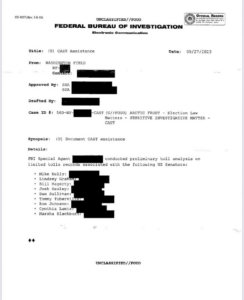

Weaponization of the FBI
Operation Arctic revealed that more than 200 Republican activists, including Charlie Kirk and Dan Scavino, were being carefully observed to stop their activism. (Arctic Frost investigation, 2022)
Even lesser-known people, like Republican People of Color members and author Mohamed Ahmed, were treated the same way. We patiently await transparency, accountability, and reform to regain our freedom, liberties, and rights. Hence, till today, we’ve been covertly up here, dueling with what they unleashed on us on steroids—we’ve written a free book, Dissident in America, which you can download for free below. About my experience. patience is a virtue and one day even I will be fully free to be all I can be in America.
The Trump administration made most of this information public, showing how close America came to having a homegrown spy system like Communist East Germany’s STASI POLICE, a system used by government bureaucracy against Republicans. (Lichter et al., 2020)
President Trump himself saw his Mar-a-Lago home raided, his wife’s closets searched, and his son Barron’s room tossed. But the shockwaves from that spectacle spread far beyond headlines about a former president.
As the news broke, everyday Americans like Susan Miller, a retired school secretary from Ohio, watched live coverage and experienced a chill, wondering if their homes, too, could be swept up in a search based purely on suspicion or political targeting. “If they can do that to a former president, what could stop them from coming for regular people like me?” Susan later shared with her local paper. Her trust in the system, built over decades, was badly shaken. Susan’s reaction is not just her own—it reflects an increasing unease among citizens across the country who now worry about the reach and accountability of government power.
When ordinary Americans see someone at the very pinnacle of public life subjected to this level of examination and force, the sense of vulnerability becomes universal. This kind of fear erodes trust and stresses exactly why clear accountability and transparency must be restored.
However, times like these are also a sign that we are not powerless. By engaging in civic life—voting in every election, championing reforms, and joining forces in our communities—citizens can demand change. When Americans organize, speak up, and hold leaders responsible, the system can respond. Each action, no matter how small, contributes to rebuilding the trust and balance that our country depends on. Cases like Susan’s, multiplied thousands of times in living rooms nationwide, show that although the challenges are real, the solution starts with each of us.
If we act, we can rebuild trust in our system and ensure accountability. Helped by the rise of some citizens exercising their version of Free People Power in elections by the ballot, some Americans, returning Trump to the presidency made this disclosure possible, as these actions had been hidden behind classification barriers, even from honest agents within the FBI.
Former Deputy Director Dan Bongino summarized it clearly: there are two FBIs in America.
1. One that protects, serves, and would take a bullet for any American.
2. The other acts as social activists for a government run by bureaucracy for the people, using intimidation, wiretaps, fake FISA warrants, and suppressing political opposition.
Parents who spoke out against school board decisions, churches against abortion for religious reasons, and people standing up for traditional American values all faced the “2nd version of old FBI treatment.” Meanwhile, most dedicated heroes of agents kept focusing on terrorists, criminals, child abusers, pedophiles, spies, and people who commit financial crimes.
Accountability and Structural Reform
The political bias came from leadership culture centered on the Hoover Building’s 7th floor, where over one-third of the agency was based in Washington, D.C. This culture turned parts of the FBI into tools of the swamp.
Accountability started under the Trump administration, applying specific tools such as Section 7531 of the Intelligence Reform and Terrorism Prevention Act, as well as internal DOJ Inspector General referrals and Office of Professional Responsibility protocols. These measures enabled firings and retirements led by FBI Director Kash Patel and DOJ guidance from Pam Bondi. By relying on internal disciplinary processes and strengthening protection for whistleblowers reporting abuse, the administration created a framework for culture change.
This approach also reflects principles from institutional theory: decentralizing agents and empowering field professionals are consistent with the model of “autonomous professionalism”—where agents are entrusted with independence to focus on their core mission, rather than being driven by centralized bureaucracy. Such a connection has been proven to foster stronger mission focus, greater citizen trust, and greater capacity for adaptation in complex organizations. (Agile Purpose: Overcoming Bureaucracy, n.d.) Power is being spread out, sending heroes of the New FBI agency back out to do what they do best: Protect America.
Oversight and the Way Forward
Reform is happening through the Senate Judiciary Committee, led by Chuck Grassley of Iowa and joined by leaders such as Amy Klobuchar of Minnesota. Importantly, these efforts demonstrate that oversight and reform are being undertaken by Republicans and Democrats working together, showing that a commitment to transparency and accountability can rise above partisan divides. Bipartisan initiatives such as recent joint hearings and investigations illustrate that when lawmakers from both parties collaborate, the public gains confidence that reforms are driven by shared values rather than political interests.
This concern is similar to what the Church Committee faced in the 1970s. As the Church Committee wrote in its final report, “The potential for abuse is too great to leave intelligence activities unchecked by proper oversight.” Quoting this warning from the past underscores the continued importance of strong oversight.
To help turn accountability into action, the Senate Judiciary Committee should commit to publishing quarterly compliance audits, made available to the public, and to reporting on progress toward openness and accountability benchmarks. Having these measurable milestones will allow citizens to follow results directly and ensure elected officials are held to real deadlines. However, the level of political bias under the Biden government FBI was greater than ever, targeting Republicans, activists, officials, and even a former President.
A Call for Calm, Due Process, and Bipartisan Reform
Even as someone critical of FBI misconduct, I urge calm and respect for due process. We can peacefully and nonviolently make the agency transparent, accountable, and reformed. A weaponized FBI agency helps no one.
In the 1960s, politicized scrutiny was used against civil rights leaders and anti-war activists on the left spectrum of American politics; after 2016, it has been used against Republicans, the right spectrum of America.
We urgently need transparency, accountability, and reform to stay Free People Power.
Our government should work for us, not prey on us.
Today, the FBI has very low poll numbers. NBC News Poll (July 2023): Only 37% of registered voters had a positive view of the FBI. This was a distinct decline from 2018, when 52% viewed the agency favorably. (Henninger, 2023)
Now Democrats fear the same weaponization that was once used against Republicans. This is a warning for both parties. We need the New transparent, accountable and reformed FBI’s strength now more than ever, but without corruption.
Republican People of Color call for reform without destroying the agency. Remove bad leaders. Bring back checks and balances. If FBI leaders failed Republicans, they will fail Democrats, too.
This is not about party politics; it is about the Constitution.
Conclusion: Free People Power or Big Brother
If reform fails, America faces higher taxes, bigger government, and a growing Big Brother system. We risk losing what made us the last bastion of freedom. Picture a near future: a young family in Ohio, both parents working full-time, sees nearly 60 percent of their income taken by federal, state, and local taxes, fees, and hidden levies. (Ohio’s State and Local Tax Burden, 2024) Their take-home pay barely covers escalating rent and basic groceries, while new regulations require permission for everything from starting a small business to making home repairs. Cameras watch city streets, and digital checkpoints flag unusual purchases or political activity for review. Every day, freedoms begin to feel out of reach, and trust in government fades into fear. Without urgent civic action now, this could become America’s reality, showing why each of us must demand reform, transparency, and accountability—and why each and every voice and vote indeed matters.
Help the Trump administration deregulates, cut taxes, and end the weaponized two-tier system, so America remains Free People Power, not turn into the old world many fled to find a home sweet home. The land of the Free and home of the brave to keep that Free people Power!
Every citizen has a role to play in this effort. Vote in local and national elections for candidates who support reform, contact your representatives to demand greater transparency and accountability, and speak up in your community to encourage others to keep informed. Attend local town halls and public meetings to voice your concerns directly to officials. Join or start local reform groups focused on transparency and accountability, so you can work with neighbors to organize petitions, campaigns, or informational events. Volunteer your time for civic organizations or efforts that promote government reform to help spread awareness and support change on the ground. Simple actions like sharing accurate information with friends and family, writing letters to the editor in your local paper, or participating in peaceful demonstrations can make a difference. By adopting these steps, ordinary Americans can help preserve the spirit of liberty alive and ensure that government truly serves the people.
References
Edwards, C. (March 22, 2023). Federal Spending Up 40 Percent Since 2019. Downsizing the Federal Government. https://www.downsizinggovernment.org/federal-spending-40-percent-2019
(OECD), O. f. (n.d.). Revenue Statistics 2024 – the United States. https://www.oecd.org/tax/tax-policy/revenue-statistics-united-states.pdf
(March 31, 2022). Arctic Frost investigation. Wikipedia. https://en.wikipedia.org/wiki/Arctic_Frost_investigation
Lichter, A., Löffler, M. & Siegloch, S. (2020). The Long-Term Costs of Government Surveillance: Insights from Stasi Spying in East Germany. Journal of the European Economic Association 19(2). https://doi.org/10.1093/jeea/jvaa009
(2024). History of the United States government. Wikipedia. https://en.wikipedia.org/wiki/History_of_the_United_States_government
(2025). How many civilian jobs are in the US federal government? USAFacts. https://usafacts.org/answers/how-many-civilian-jobs-are-in-the-us-federal-government/country/united-states/
McDonald, P. (2025). The Federal Technocracy: How the Administrative State Eroded Popular Consent. The Independent Review 30(4), pp. 453-470. https://doi.org/10.3998/integrity.30.4.453
(April 4, 2025). U.S. Debt by President: Dollar and Percentage 2025. ConsumerAffairs
. https://www.consumeraffairs.com/finance/us-debt-by-president.html
(December 20, 2000). Community Renewal Tax Relief Act of 2000. United States Congress. https://en.wikipedia.org/wiki/Community_Renewal_Tax_Relief_Act_of_2000
Rosenblum, J., Kenworthy, L. & Nygård, M. (2025). Power and inequality: determinants of income inequality in rich capitalist democracies, 1960 to 2019. Socio-Economic Review 23(2). https://doi.org/10.1093/ser/mwae071
Marr, C. & Jacoby, S. (November 1, 2021). Build Back Better requires the highest-income people and Corporations to pay a fairer amount of Tax, reducing the tax gap. Center on Budget and Policy Priorities. https://www.cbpp.org/research/federal-tax/build-back-better-requires-highest-income-people-and-corporations-to-pay
Kim, J., Kim, D., Jeong, J., Oh, A., & Kim, I. S. (2025). Measuring Interest Group Positions on Legislation: An AI-Driven Analysis of Lobbying Reports. arXiv preprint. https://doi.org/10.48550/arXiv.2504.15333
(2024). Troubled Asset Relief Program. Wikipedia. https://en.wikipedia.org/wiki/Troubled_Asset_Relief_Program
(2025). How many people work for the federal government?. USAFacts. https://usafacts.org/articles/how-many-people-work-for-the-federal-government/
Sánchez, D. & Brady, D. (2024). Revealing Hidden Spending in Federal Budget Reports. National Taxpayers Union Foundation. https://www.ntu.org/foundation/detail/revealing-hidden-spending-in-federal-budget-reports
(May 18, 2023). FBI Section 702 Query Violations. https://www.cnbc.com/2023/05/19/fbi-broke-rules-in-scouring-foreign-intelligence-on-jan-6-riot-racial-justice-protests-court-says.html
(n.d.). Agile Purpose: Overcoming Bureaucracy. https://link.springer.com/chapter/10.1007/978-3-030-17674-7_6
Henninger, D. (July 20, 2023). The FBI Loses the Public. The Wall Street Journal. https://www.wsj.com/articles/the-fbi-loses-the-public-603488
(2024). Ohio’s State and Local Tax Burden. Legislative Service Commission. https://www.lsc.ohio.gov/assets/organizations/legislative-service-commission/files/current-ohio-facts-state-and-local-tax-burden-august-2024.pdf