
A Somali American Activist’s Take on Assimilation—Past and Present Struggles in America
- Articles
republipeclr
- 0
- 13 minutes read
A Somali American Activist’s Take on Assimilation—Past and Present Struggles in America
Assimilation has defined America’s evolving identity, shifting from exclusionary, race-based policies to a more inclusive, pluralistic ideal. Its history reveals continual debates over what it means to belong.
This article traces how cycles of inclusion and exclusion reveal persistent anxieties and hopes about American identity.
Assimilation in America: A Historical and Quantitative Analysis.
Assimilation in the U.S. is shaped by law and politics, with ‘melting pot’ and ‘segmented assimilation’ models . group integration. The ‘melting pot’ model describes the idea that immigrants from diverse backgrounds blend together to form a unified American identity, often by shedding distinct cultural and religious or lack thereof traits. In contrast, ‘segmented assimilation’ recognizes that different immigrant groups may integrate into society in multiple ways, sometimes maintaining their cultural traditions or experiencing varied economic and social outcomes depending on factors such as race, class, and community support. Like a salad bowl. Each immigration wave has triggered nativist backlash and stricter laws, keeping American identity in constant flux. The melting pot has America obese, and the salad approach has it starving for real food in authenticity. To understand it one must go back into the past.
I. A Timeline of Assimilation: Immigration Law and Public Attitude
Early Foundations (1790–1860): Assimilation Defined by Race and Religion
Early laws like the 1790 Naturalization Act restricted citizenship to “free white persons,” tying assimilation to race.
By the mid 1800s, immigration surged:
Foreign-born share in 1850: 9.7%
Foreign-born share in 1860: 13.2%
Foreign-born share in 1890: 14.8% — the highest until the 21st century.
Nativist movements like the Know-Nothing Party demanded assimilation into Anglo-Protestant norms, excluding those who didn’t conform.
Exclusion Era (1882–1924): Racial and Ethnic Exclusion Codified
Federal policy enforced racial exclusion with laws like the Chinese Exclusion Act (1882), Geary Act, and literacy targeting “unassimilable” groups.
Immigration volume soared during this era:
33.4 million immigrants arrived between 1820 and 1920.
1907 peak: 1,285,350 admissions — the highest single-year total in U.S. history.
Ellis Island processed over 12 million immigrants between 1892 and 1954.
When more immigrants began arriving from Southern and Eastern Europe instead of Northern Europe, nativists claimed these groups were “less assimilable.” This argument helped pass the strictest immigration law in U.S. history:
The 1924 National Origins Act engineered immigration to favor Northern Europeans and drastically cut “undesirable” groups.
Annual admissions fell below 300,000 for decades — the lowest sustained immigration levels since the mid 19th century.
Assimilation laws reinforced exclusion, discrimination, and lasting barriers for many groups, creating a precedent for recurring cycles of restriction.
The 1965 Immigration and Nationality Act: Opening the Door to Multiculturalism
The 1965 Hart–Celler Act abolished racial quotas, opening immigration and transforming U.S. demographics.
Foreign-born share in 1970: 4.7%
Foreign-born share in 2000: 11.1%
Foreign-born share in 2022: 13.9%
Foreign-born share in 2025: ~16% — the highest since 1890.
More than 70 million people have immigrated since 1965, reshaping American culture, politics, and economics.
Recent decades have seen debates over bilingual education, DACA, and sanctuary policies, reflecting tension between diversity and unity. These policies made assimilation more contested but also more inclusive.
II. Statistical Highs and Nativist Lows: Immigration, Law, and Backlash
The Recurring Pattern
Across American history, peaks in immigration have consistently correlated with the rise of nativist movements:
Era Foreign-Born Share Nativist Movement
1850s 13% Know-Nothing Party
1890s 14.8% Anti-Chinese laws, labor riots
1920s 13.2% National Origins Act,
2016–2026 13–16% English-only bills, immigration moratorium proposals
Early 20th Century: Forced Americanization
By 1923, 34 states had English-only laws, enforcing conformity and erasing immigrant languages.
Modern Era (2000–2026): The Cycle Continues
Immigration again reached historic highs:
1.17 million people obtained permanent residency in FY2023.
132 million nonimmigrant admissions were logged the same year.
As numbers rose, political rhetoric mirrored earlier eras:
Calls for English-only federal laws
Proposals to end birthright citizenship
State-level refugee restrictions
Efforts to reduce legal immigration pathways
The same worries that led to restrictions in the 1920s have resurfaced in the 2020s, showing how American reactions to demographic changes often recur.
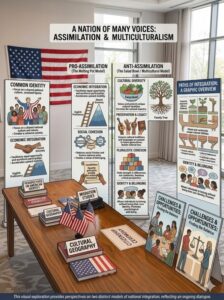
III. Manifestations of Assimilation: Law, Culture, and the American Ideal
Compulsory Assimilation
Historically enforced through:
Native American boarding schools
English-only laws
Anti-miscegenation statutes
Segregation and racial exclusion
Coercive assimilation policies caused lasting harm. After 9/11, Muslim Americans faced renewed pressure, echoing earlier eras. Some argue shared civic identity helps unity, but impacts remain debated.
Voluntary Assimilation
Measured through:
Language acquisition
Intermarriage (over 50% for many immigrant groups — inference based on national demographic trends)
Economic integration
Immigrants now make up 18% of the U.S. labor force, showing economic integration.
Pluralistic Assimilation
The modern era embraces:
Bilingual education
Ethnic enclaves
Multicultural civic
participation
Congress is more diverse than ever, reflecting a broader, more inclusive national identity.
Assimilation has changed from requiring everyone to be the same to encouraging participation from many different groups.
IV. Conclusion: Assimilation, Nativism, and the Future
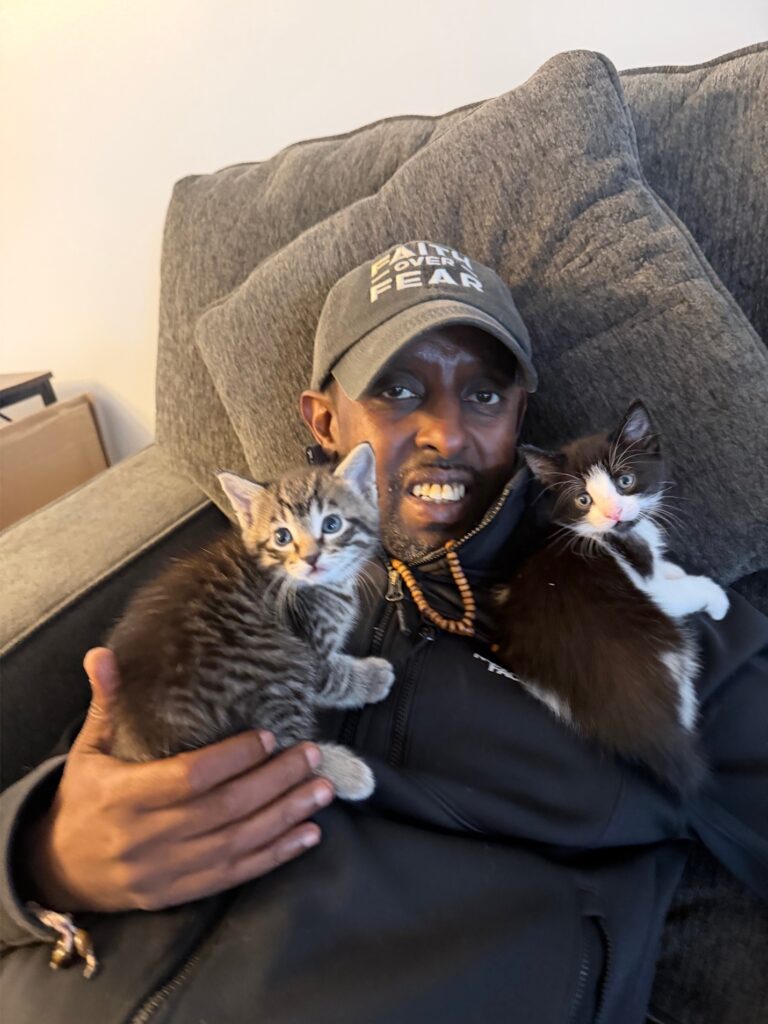
Assimilation is cyclical: each wave brings change and backlash, with recurring debates over identity and belonging. As a Somali American and a member of the Republican People of Color, I experience these cycles firsthand. Our community often faces questions about whether we truly belong, especially given the challenges of national security scars and social suspicion—even from law enforcement. Through this adversity, I continue to identify as a Republican but most important proudly American, because I believe in the principles of free will, limited government, the right to bear arms, capitalism, and individual faith. My personal experience reflects the broader American story, where political identity and cultural heritage intersect with the ongoing conversation about what it means to assimilate and belong. Despite increasing social divisions, voices like ours are part of the evolving American fabric, striving to participate fully while holding onto both our heritage and our values. Despite stacked odds against us ever increasing.
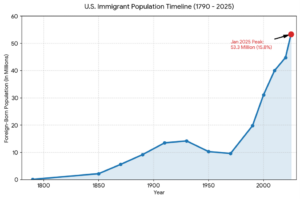
Today, with immigration at its highest level in more than a century, the nation faces familiar questions:
What does it mean to belong?
How should newcomers integrate?
Assimilation remains both a challenge and a hope, balancing heritage and identity and shaped by law, politics, and ideals.
V. Personal Reflections and Contemporary Perspectives on Assimilation
In today’s debates, the concept of assimilation is often weaponized in political discourse, especially against communities of color. As Somali Americans, we see how our community is sometimes used as a punchline or example of ‘not assimilating’—a label that ignores the complexity and reality of our experiences. We are mostly first-generation Americans, raising children born in the U.S., striving to instill in them a sense of belonging and pride in both their heritage and their American identity.
Assimilation, at its core, should not be about erasing differences or achieving some lowest common denominator. I believe that the common ground in America is most often defined by English language proficiency and a shared respect for the Constitution, liberty, and inclusion. The real goal should be to build a pluralistic society where everyone, regardless of ethnicity, religion, or background, feels empowered to participate fully in civic life. But really, if you look at America beyond the outrage meter spectrum, we are closer to that than further from it. No other nation has empowered the Somali community more than America has in this generation. That is a fact lost on many: we do have it good here more than in most places on earth. For America is the Free People Power nation, well, for most of us, not all, but that is better than most nations. Why we love it here, despite what you are seeing and what some of us, like this author, are experiencing in America. We, the people, of America are awesome. This is still a FREE COUNTRY.
At the same time, it is important to acknowledge that significant barriers remain for many immigrant communities. Discrimination, economic inequality, and social suspicion can make the process of belonging painful and uneven. Not everyone has experienced the same opportunities, and challenges of bias and exclusion persist alongside the freedoms and possibilities that America offers. Recognizing these realities helps foster more honest conversations and better solutions as we continue striving toward a more inclusive society.
First, preserving cultural identity is essential. In Africa, a proverb says those who abandon their cultures are slaves to another. We must not force anyone to give up their cultural values and identity just to belong in America. We create in this new world Free People Power, not slaves or subjectification of others in cultures or values that are not detrimental to the American way of life.
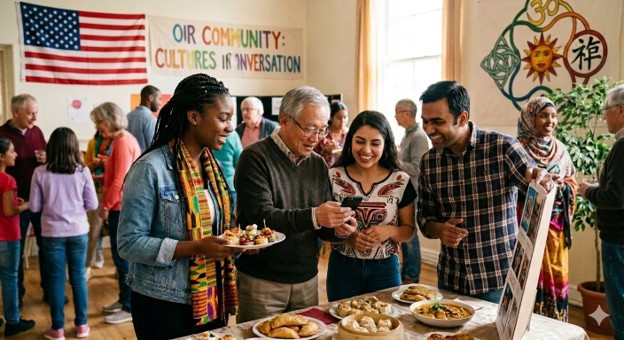
Second, America’s richness comes from its diverse communities. We are all proud of Little Italy in New York, Irish Southie in Boston, Little Havana in Florida, German towns, especially during Oktoberfest, and Black Harlem in New York. These places and traditions are what make America unique. Newcomers should also be able to celebrate their own cultures and contribute to American life, as long as this does not cause harm or undermine shared civic values.
Third, there should be no expectation of whitewashing everyone’s culture, values, and ethos into something we are not. Instead, if we all uphold the values of our Constitution and are willing to serve America in many capacities, the spirit of freedom and pluralism can continue for the next 250 years, inshallah.
As a Somali American, my experience reflects the recurring cycle: struggle, exclusion, and debate over belonging. Remaining true to America and its ideals is both a challenge and a promise for newcomers.
However, the debate around assimilation remains caustic. For many immigrant groups—including Somalis—the process can be painful, marked by exclusion and repeated demands to ‘get in line,’ echoing the historical struggles faced by African Americans, Germans, Italians, Irish, Swedes, Norwegians, Eastern Europeans, Catholics, Jewish refugees, Asian Americans, Muslims which we also are, Indians, and Hispanics. Each group, at different points, has been scapegoated or excluded, whether through legal quotas, social prejudice, or law enforcement means applied exclusively to us.
There is, nevertheless, a healthy and necessary way to discuss assimilation. Instead of repeating past mistakes of exclusion and forced conformity, America must ask: Who are we as Americans? What collective ethos unites us in the face of growing social atomization? How do we create a society where people can maintain their identities while also belonging to the larger whole? And most importantly, what values are truly non-negotiable, without resorting to rejecting anyone because of their ethnicity, religion, sexuality, nationality, or creed?
To move forward, America should promote civic education, dialogue, and integration—uniting diverse communities while upholding democratic values.
America faces critical questions about inclusion and identity. Assimilation has shifted from exclusion toward pluralism, but remains an ongoing cycle shaped by law, law enforcement agencies, culture, and debate. Each wave of newcomers faces resistance yet helps redefine what it means to belong. Take my example as Dissident in America. Read the Free BOOK on this site. www.rpoc.org I am also writing a third book which inshallah shall be available soon, for free too, for this is works for God, Country and Humanity for Free People Power: America.
If still alive and free in America. It is what it is too.
Mohamed Ahmed chose to be true to America despite federal means of censorship, embargo and blacklisting in America. It is what it is. Yet hope in America by black, Muslims, Somali, immigrant is not diminished because of what it is supposed to be for us not aberrations of it. America is an ideal for us a promissory note of Free will and works for good for God, country and humanity. The new world unlike anything on this planet. Worth fighting for America as a whole and fighting for our black, Muslim, Somali immigrants’ freedoms, liberties and rights like all immigrants who came before us to belong or get kicked out of it. As some believe even in our federal agencies now joined by some in the public with covert means applied. To get us there by other means.
America is a promissory value oriented nation of a constitutional basis of free will on earth of free people power, sometimes going exclusive, purist and nativist, but we are multi everything in this country, our democracy reflects it. It is an ideal that many people from many identities can come together despite their enormous differences build a nation together with self-determination of We, the People, under red, white and blue ideals of freedom, liberty and rights.
With that Republican People of Color say, let the assimilation process commence and we happily engage for this is a two-way street of values between natives and immigrants as has been in the past so shall it be today. History bears us out in testimony of the glory of America towards more inclusion than exclusion over time. This ebbs and flows and this midterm elections and future ones an issue of politics in America. This issue is now on the ballot in America coming fast. Which side of the assimilation debate you stand on is some decision-making process of voters in America.
And yes, political correctness is out the window on this one. Because of the sensitivities involved, whatever one says they will be labelled racist, xenophobes or worse a Nazi. But really America we need to have this debate. We cannot atomize ourselves into enclaves without being whole America. No Nation can survive that. Define assimilation and then go about reinventing what it is to call ourselves Americans.
What is an American?
We say at Republican people of Color, it is the land of the free and home of the brave.
Be brave and engage is all our duty. We all belong to this land no exclusion or exception of any is our goal. This is our road to Canaan for some of us Somalis in America. May it be easy for us all, and always God bless America, all our home sweet home. Until federal agencies and government types tell us different, we remain true to America.